
Cold Email Playbook: Volume vs. Targeting — Which Strategy Actually Wins?
We compare high-volume automation against precision targeting in cold email outreach — measuring CAC, reply rates, and deliverability so you can choose the right approach for your sales motion.

When B2B marketing teams argue about cold email, they almost always argue about the wrong thing: "Does cold email still work?" It does — but depending on how you run it, it's either your lowest-cost lead generation channel or the thing that burns your domain reputation to the ground. The real distinction isn't about the channel itself; it's about two fundamentally different philosophies. The volume-first approach sends the same template to hundreds of prospects per day. The targeting-first approach sends a precise, contextually relevant message to a smaller set of high-fit accounts. This guide puts both side by side, compares them on the numbers that matter, and tells you plainly which one to use — and when.
Two Philosophies, Two Cost Structures
The logic of volume-first outbound is straightforward: if you reach a large enough list, even a low reply rate generates enough pipeline. Unit economics are built around send volume. Even at a 1% reply rate, 500 emails per day × 30 days = 15,000 touches, which theoretically yields 150 replies per month. On paper, the math holds. Targeting-first does the opposite: concentrate the same effort on 200–300 high-fit accounts, tailor every message to the recipient's industry and current signals, and aim for reply rates in the 8–15% range.
From a marketing director's perspective, the difference shows up in your CAC line. With volume, costs accumulate in sending infrastructure, multiple domains, and list acquisition. With targeting, cost shifts to research and personalisation time — human hours. Neither is free; they just place the cost in different buckets. The right question isn't "which is cheaper?" It's "which unit economics fit my average contract value (ACV) and sales cycle length?"
Reply Rate: The Metric That Misleads
Volume advocates usually rest their case on a single argument: "A low reply rate doesn't matter — I compensate with scale." This is incomplete accounting at the lifecycle level. Reply rate is not the only metric that matters in a cold email funnel. What you actually need to measure is a chain: deliverability rate → open rate → positive reply rate → meeting conversion rate.
High-volume sending sabotages the first link in that chain. ESPs like Gmail and Outlook apply behavioural signals: a sender domain where large numbers of recipients don't open, delete, or mark as spam gets graylisted quickly. So as you scale volume, deliverability falls — and your actual reach lands far below what you assume. You think you've sent 15,000 emails; 9,000 of them are in Spam or Promotions. Targeting-first avoids this: low volume, high relevance, low complaint rates keep domain reputation structurally healthy — which keeps deliverability high.
We'll be direct here: in mid-to-high ACV B2B sales with multi-stage sales cycles, targeting-first almost always wins. A single well-qualified meeting is worth more than hundreds of dead-end touches, and your sending reputation is a long-term asset that compounds — or erodes — over time.
When Does Volume Make Sense?
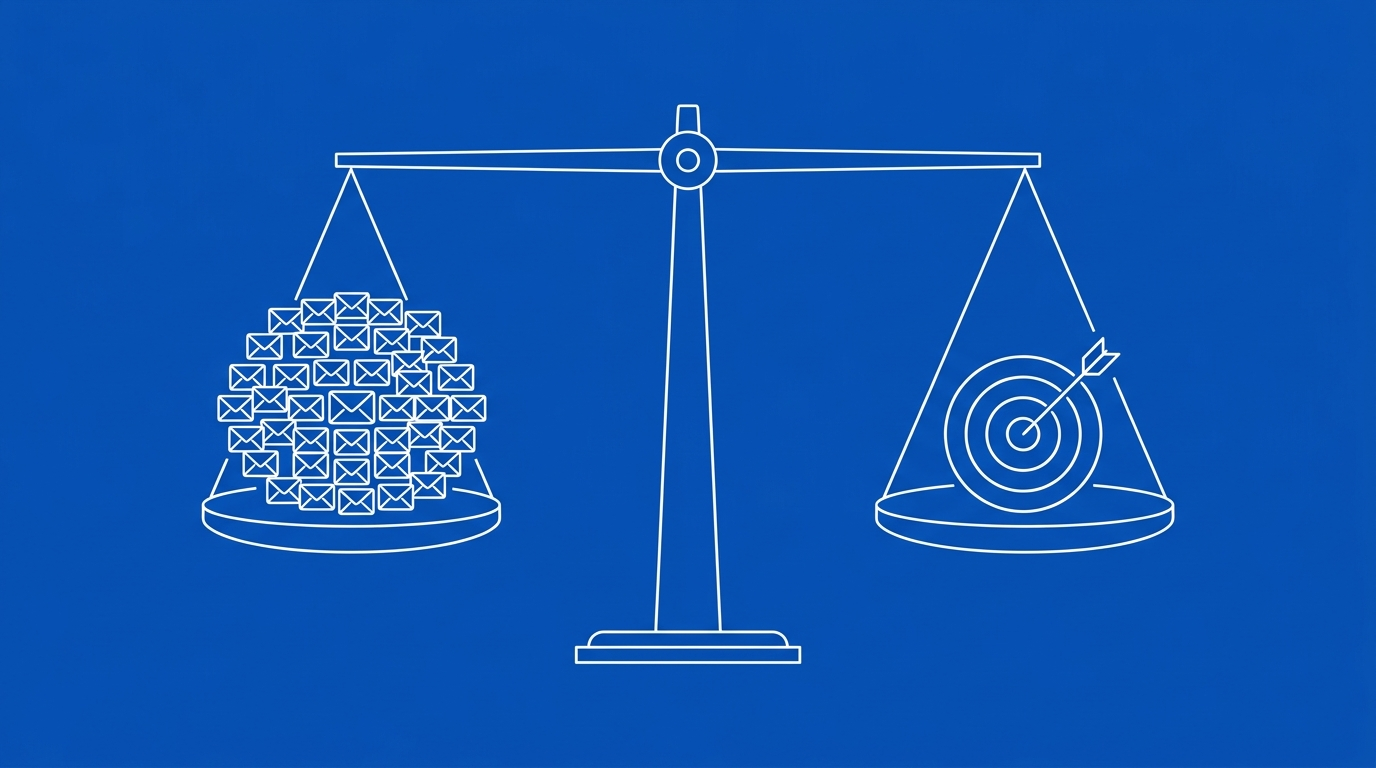
That said, dismissing volume entirely would be intellectually dishonest. For low-ACV, high-velocity, near-self-serve products — think a lightweight SaaS subscription where the deal closes in a single async interaction — spending 20 minutes researching each lead simply doesn't pencil out. The cost structure of that business requires broad, fast reach; deep personalisation is overkill relative to the deal size.
A second legitimate scenario: you're in the very early stages of go-to-market and you don't yet know your ideal customer profile (ICP). Here, volume functions as a discovery tool — expensive but fast. Running a wide campaign to learn which industry verticals, job titles, and pain points generate replies gives you the signal you need to narrow down. The critical rule: treat volume as a temporary ICP-calibration phase, not a permanent strategy. The moment you have signal, compress.
In practice, most B2B teams don't live at either pure extreme — they operate somewhere on a spectrum. The real question isn't "500 emails or 50?" It's how much relevant context you embed in each touch.
Personalisation: What's Actually Expensive (And What Isn't)
The most common objection to targeting is that it doesn't scale: "If I spend 20 minutes per email, I can reach maybe 40 companies a month." This objection is wrong because it misdefines personalisation. Effective cold email personalisation is not reading each prospect's LinkedIn posts one by one. It's the systematic combination of the right segment + the right signal + the right opening.
Think of personalisation in two layers. The first is segment-level: a strong, well-constructed framework written for companies that share the same industry, size, and pain point. This layer is written once and works across hundreds of accounts. The second is line-level: one specific signal about that company — a recently opened location, a broken or missing website, a new regulation hitting their sector. That line is what lifts the message from "template" to "relevant" — and it's the part people assume is expensive.
But this second layer is increasingly automatable. Modern outreach tools can gather firmographic data (industry, location, website status, headcount) and generate a personalised opening line for each account. In LeaderMix, for example, the workflow runs like this: discover businesses via a live Google Maps search, find and verify their email addresses, then let AI draft a message tailored to each company's specific weak spot. What you gain is the reply rate of targeting with something approaching the operational throughput of volume — the genuine synthesis of both philosophies.
Deliverability Infrastructure: Non-Negotiable for Both Approaches
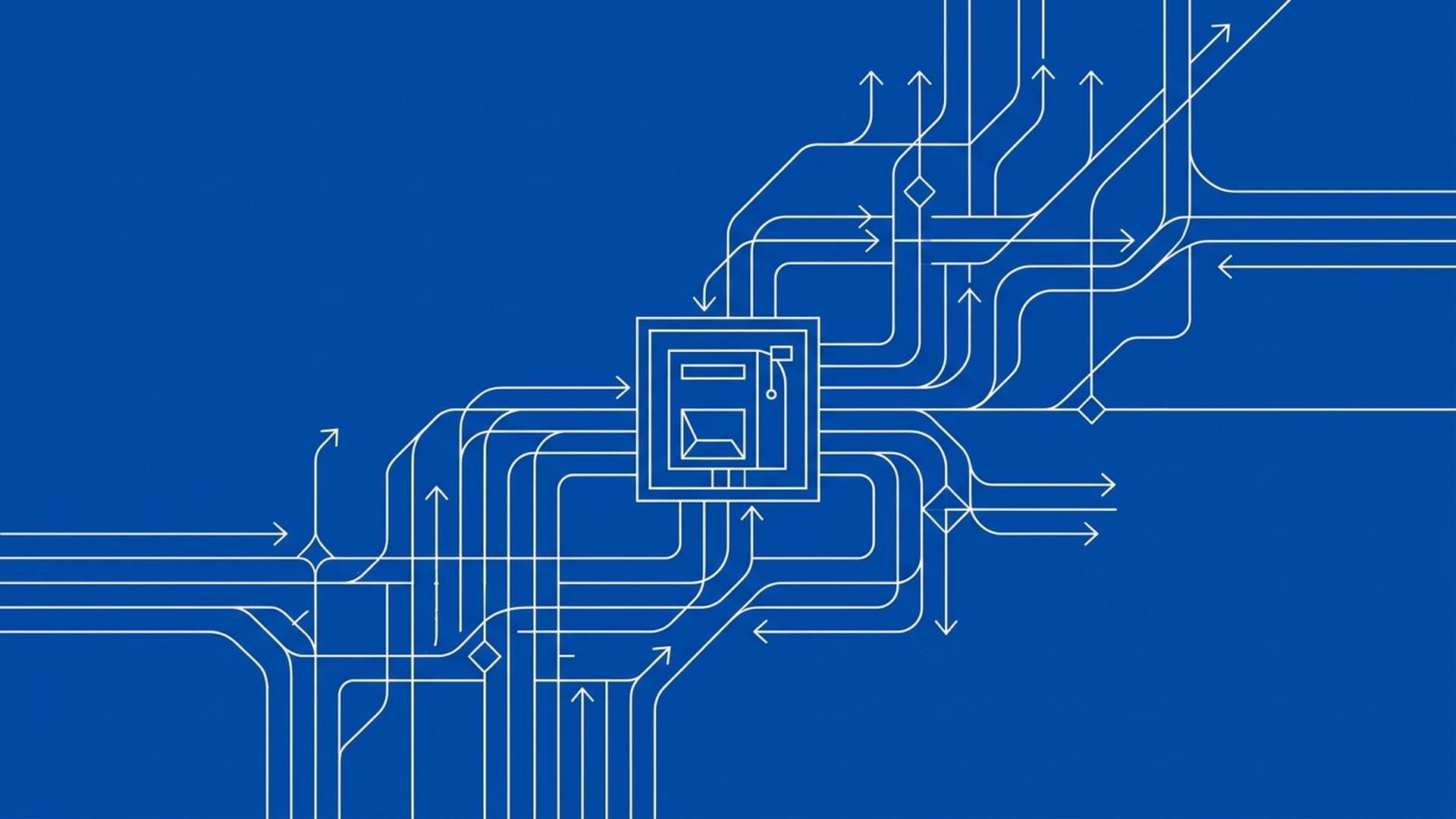
Whichever philosophy you choose, if your emails aren't landing in the inbox, the rest of your strategy is irrelevant. Deliverability is the invisible but decisive layer of cold email, and the two approaches manage it very differently.
First, the technical baseline is identical for both sides — and non-negotiable: SPF, DKIM, and DMARC records must be correctly configured on your sending domain; new domains must be warmed up over 2–4 weeks before ramping volume; and your primary corporate domain should never be used for cold outreach — register a dedicated sending subdomain. These are basic hygiene steps that protect your reputation.
The real divergence happens at the behavioural layer. Volume-first tries to solve deliverability by distributing load across multiple domains and mailboxes — a fragile and costly game, because every new domain is a new reputation risk. Targeting-first solves deliverability at the source: low volume, high relevance, and low complaint rates protect the domain structurally. Sending at a natural, paced rhythm instead of burst-firing, carrying a single clear intent per email, and making the opt-out path obvious all keep behavioural signals positive. LeaderMix's deliberate pacing between sends and automatic opt-out linking are built on exactly this logic — protecting cadence and reputation, not maximising raw volume.
One more point worth noting for globally-operating teams: compliance with GDPR (for EU prospects) and equivalent privacy regulations is directly tied to how you handle opt-outs, data retention, and consent signals. A targeting-first approach — with documented opt-outs and suppression lists — makes that compliance posture far easier to maintain than a spray-and-pray blast campaign.
The Follow-Up Sequence: Where Conversions Actually Happen
Another major difference between the two approaches is follow-up discipline. The majority of replies to cold email come from later touches in a sequence — abandoning the thread after a single email is one of the most common and costly early-exit mistakes in outbound attribution. But here too, volume-first and targeting-first behave differently.
In volume-first, follow-ups typically go out to the same list as empty "just bumping this up" reminders. That drives complaint rates up and deliverability down. In targeting-first, each follow-up adds a new angle of value: the first email addresses the pain point, the second adds a case study or relevant industry data point, the third is a short, respectful close — a gentle break-up note. A 3–4 touch sequence that adds value and gets progressively shorter converts at a dramatically higher rate than a single send. The rule is clear: measure your follow-ups by the value they add, not by their frequency. If you have nothing new to say, don't send that follow-up.
Which Should You Choose? A Decision Framework
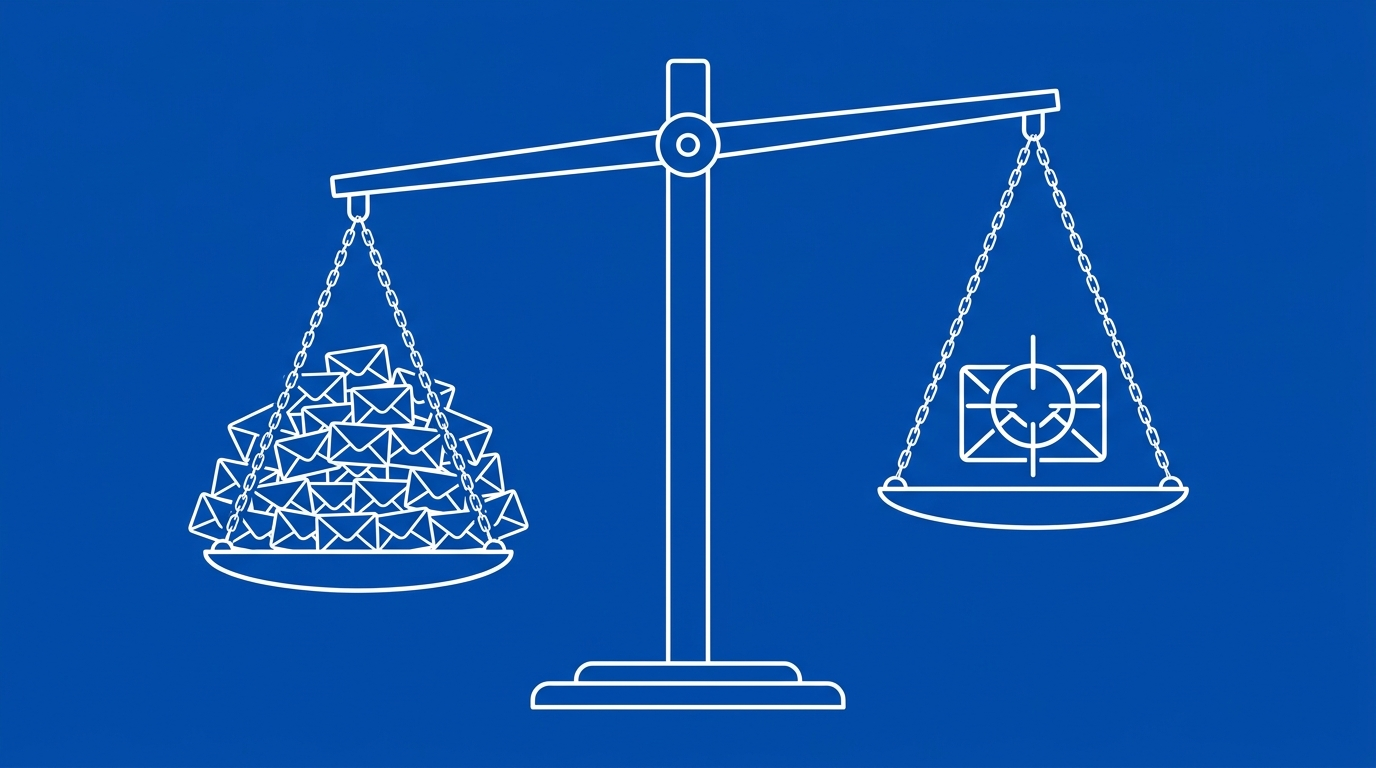
Here's a concrete framework for making the call. Choose the targeting-first approach when:
- Your average contract value is mid-to-high and your sales cycle runs longer than a few weeks
- You know your ICP and have a narrow but well-defined target market
- Your domain reputation is a long-term asset you want to protect (it always is)
- Your sales team is fed better by fewer, high-quality meetings than by raw pipeline volume
Lean toward a volume-first approach if:
- You're selling a low-ACV, fast-closing, near-self-serve product
- You don't yet know your ICP and need rapid signal collection (treat it as a temporary discovery phase)
- The per-lead research cost exceeds the conversion value of each lead
For most B2B marketing teams, the right answer isn't one pure extreme — it's targeting amplified by automation: humans write the segment-level framework, machines handle line-level personalisation and data gathering, and the system enforces deliverability hygiene and follow-up discipline. This synthesis captures the reply rate of targeting and the operational throughput closer to volume.
Measurement: The Right Funnel Metrics
Whichever approach you choose, let data drive the decisions — which means tracking the right metrics. Reply rate in isolation misleads. Track this full chain weekly: deliverability rate → open rate → positive reply rate → meeting rate → opportunity rate. To tie cold email back to CAC, work backwards from closed revenue through each conversion point in the chain. That way, instead of the instinct to "just send more emails," you'll see exactly which stage is the bottleneck and direct your effort there.
One important caveat: open rates are increasingly unreliable due to privacy features like Apple Mail Privacy Protection, which auto-loads tracking pixels regardless of whether the email was actually read. Use open rate as a relative comparative signal, not an absolute success indicator. Your real decision metrics are positive reply rate and meeting rate.
The Takeaway
The volume-vs-targeting debate in cold email is ultimately a budget decision about where to place your resources. Our clear recommendation: if you're running mid-to-high ACV B2B sales, choose targeting — but delegate the expensive part of personalisation (data gathering and line-level openers) to automation. If there's one thing to change this quarter, don't increase your send volume. Instead, pick one narrow segment, write one strong framework message for that segment, and build a 3-touch, value-adding follow-up sequence. Measure positive reply rate over the next 30 days — the numbers will tell you exactly which direction to scale.
If you want to run this entire workflow from business discovery and email verification through to AI-drafted, deliverability-safe outreach in one place, explore LeaderMix's plans or browse more outbound tactics on our blog.
Soğuk listeyle uğraşmayı bırak.
Google Maps + AI seninle çalışsın. İlk 50 lead 5 dakikada hazır.
Planları İncele →